
What Is a Pearl River County Court Docket
A docket is a dated index of everything that happens in a case. Each row marks one event, such as a filing, a motion, a hearing, an order, or a final judgment. The docket lists the case number, the parties, the assigned judge, and the date of each entry. It works like a table of contents for the case. A reader can scan the docket to see when a case opened, what step it is on, and when the next court date falls.
A docket is not the full case file. The docket shows that a motion was filed. The file holds the motion itself, the exhibits, and the signed order. The docket is short and is often free to view. The full file may run to hundreds of pages, and copies can carry a fee. Many people only need the docket to confirm a hearing or check status. Lawyers and parties pull the full file when they need the actual documents.
How Pearl River County Dockets Differ by Court
Dockets in the county are split by court level, and each court keeps its own. The split follows the kind of case. Knowing the court before a search saves time, because a docket request sent to the wrong clerk leads nowhere.
Circuit Court holds dockets for felony criminal cases, major civil suits, and appeals from the lower courts. County Court handles county-level civil, criminal, and youth-related matters as assigned by state law. Chancery Court keeps the dockets for divorce, custody, probate, guardianship, conservatorship, and land or equity disputes. Justice Court and the city Municipal Courts run the dockets for traffic citations, misdemeanors, small claims, and evictions. Youth Court handles juvenile matters, and those dockets are confidential in most cases.
Pearl River County sits in the Fifteenth Circuit Court District and the Tenth Chancery Court District. A felony indictment moves on a Circuit Court docket. A divorce decree moves on a Chancery Court docket. A speeding ticket written outside a city usually lands on a Justice Court docket. A ticket from city police usually lands on a Municipal Court docket.
How to Find Pearl River County Dockets Online
Mississippi runs a statewide electronic court system called Mississippi Electronic Courts, known as MEC. MEC has been implemented for civil and criminal cases in the county's Circuit and County Courts. It is the main online channel for those dockets. Public information may be available for participating courts, though not every document or case type is open, and registered users may see more than anonymous visitors. The MEC Help Desk answers questions at 601-576-4650.
- Open the MEC portal and read the access notes, since some areas are limited to registered or attorney users.
- Pick the court that owns the case. Use Circuit or County Court for felony and major civil dockets.
- Enter a full legal name or, if you have it, the exact case number for a faster match.
- Review the docket entries in date order, then note any hearing date, motion, or disposition you need.
MEC does not replace the clerk for certified copies. A certified docket sheet or document must come from the official clerk. For courts that are not on MEC, such as Justice and Municipal Courts, the docket is reached through the clerk that holds the file. Land-related dockets are reached through the Chancery Clerk's own web inquiry tool.
Sample Pearl River County Docket Entries
Docket entries follow a life cycle from the first filing to a final judgment or appeal. The same pattern shows up in Circuit, Chancery, and the lower courts, though the wording can change. The inventory below lists the common entry types a reader will see, in the order they tend to appear, with what each one signals about the case.
| Docket Entry | What It Shows |
|---|---|
| Filing | The case is opened or a new document is entered with the clerk. |
| Summons issued | The court has ordered notice to be served on a party. |
| Service returned | Proof that a party received the summons or notice. |
| Motion filed | A party asks the judge to take a specific action. |
| Order entered | The judge issues a written direction on a request. |
| Hearing set | A date, time, and courtroom are scheduled for the matter. |
| Continuance | A scheduled hearing is postponed to a later date. |
| Plea | The defendant gives a formal response, such as guilty or not guilty. |
| Sentencing | The court orders punishment after a conviction or plea. |
| Judgment | A final or enforceable decision closes the main dispute. |
| Appeal | A party asks a higher court to review the result. |
Note: Entry labels and case-number formats should be copied exactly from the clerk or MEC, because coding varies by court and guessing can pull the wrong file.
Courts That Publish Pearl River County Dockets
Not every court posts its docket online. The county's court pages are organized by function rather than by one shared search, so each court is its own channel. The list below shows where each docket type lives and how open it is to the public.
- Circuit Court: felony criminal, major civil, and appeal dockets, reachable through MEC where available.
- County Court: county civil, criminal, and youth-related dockets, also on MEC for the county.
- Chancery Court: divorce, probate, guardianship, and land dockets, reached through the Chancery Clerk.
- Justice Court: traffic, misdemeanor, small claims, and eviction dockets, held by the Justice Court clerk.
- Municipal Courts: city ordinance and city traffic dockets for Picayune and Poplarville, kept by each city court.
The county's Justice Court page explains how that court works with the Sheriff's Department, the Mississippi Highway Patrol, and other agencies.
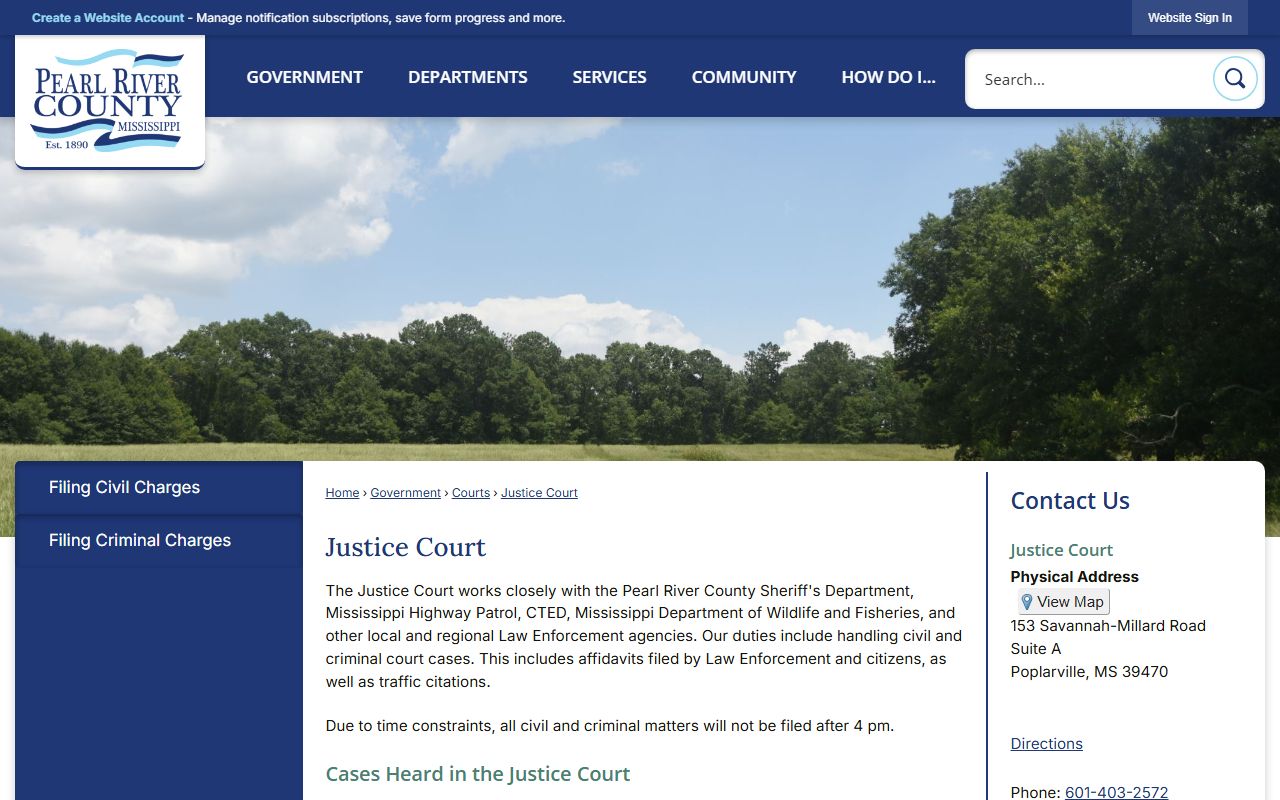
The page also notes a local filing rule: civil and criminal matters are not filed after 4 p.m., which can shift when a new docket entry posts.
Reading a Pearl River County Docket
Docket lines lean on legal shorthand, and the terms repeat across cases. Learning a few of them makes any docket easier to follow. The definitions below cover words that show up most often on Circuit, Chancery, and lower-court dockets in the county.
- Motion
- A written request asking the judge to take an action.
- Order
- The judge's written direction on a matter.
- Disposition
- The outcome of a charge or case.
- Continuance
- A postponement of a scheduled hearing.
- Capias
- An arrest order issued after a failure to comply or appear.
- Judgment
- A final or enforceable court decision.
Two dismissal terms cause the most confusion. A case dismissed with prejudice is closed and generally cannot be refiled. A case dismissed without prejudice may be brought again. Financial lines also appear, covering fines, court costs, restitution, bond, and any unpaid balance. Hearing lines list the date, time, courtroom, hearing type, and judge.
Docket vs Full Case Record
People often ask for a docket when they really want the case file, or the other way around. The two serve different needs. A docket tracks the path of a case. The full record holds the actual papers. The comparison below sets them side by side.
| Docket | Full Case Record | |
|---|---|---|
| Format | Dated list of entries | Full filed documents |
| Access | Often online and free to view | May require a fee or clerk visit |
| Use | Track case progress and dates | Legal review and evidence |
| Source | MEC or the holding court | Certified copy from the clerk |
A reader can usually inspect a public docket for free yet still need to pay for copies, request certification, or prove identity for a restricted file. The docket points to what exists. The file delivers the content.
Court Dates in Jail Profiles
The county jail roster offers a second channel for upcoming court dates. The Sheriff's Office books inmates into the Bluhorse jail roster, and an inmate profile can carry a court-history section drawn from the booking system. That section is not the same as a clerk docket, but it can confirm a hearing for someone in custody.
The court-history tab in a Bluhorse profile lists these fields:
| Field | What It Shows |
|---|---|
| Court | The court handling the inmate's matter. |
| Date | The scheduled court date. |
| Room | The courtroom assigned for the appearance. |
| Hearing type | The kind of hearing on the calendar. |
Some roster tabs, including court, bonds, and detainers, may be secured by the facility and hidden from public view. Bond and court data can also update on a different schedule than the clerk's docket. For a sentenced inmate moved to state prison, the county roster may stop showing the person, so the MDOC inmate search becomes the better source.
More Ways to Access Pearl River County Dockets
Beyond MEC and the jail roster, several channels reach docket and case information. Land-related matters in Chancery Court have a dedicated tool. Deeds, mortgages, liens, and releases are searchable through the Chancery Clerk web inquiry portal, which is useful when a probate estate involves recorded property.
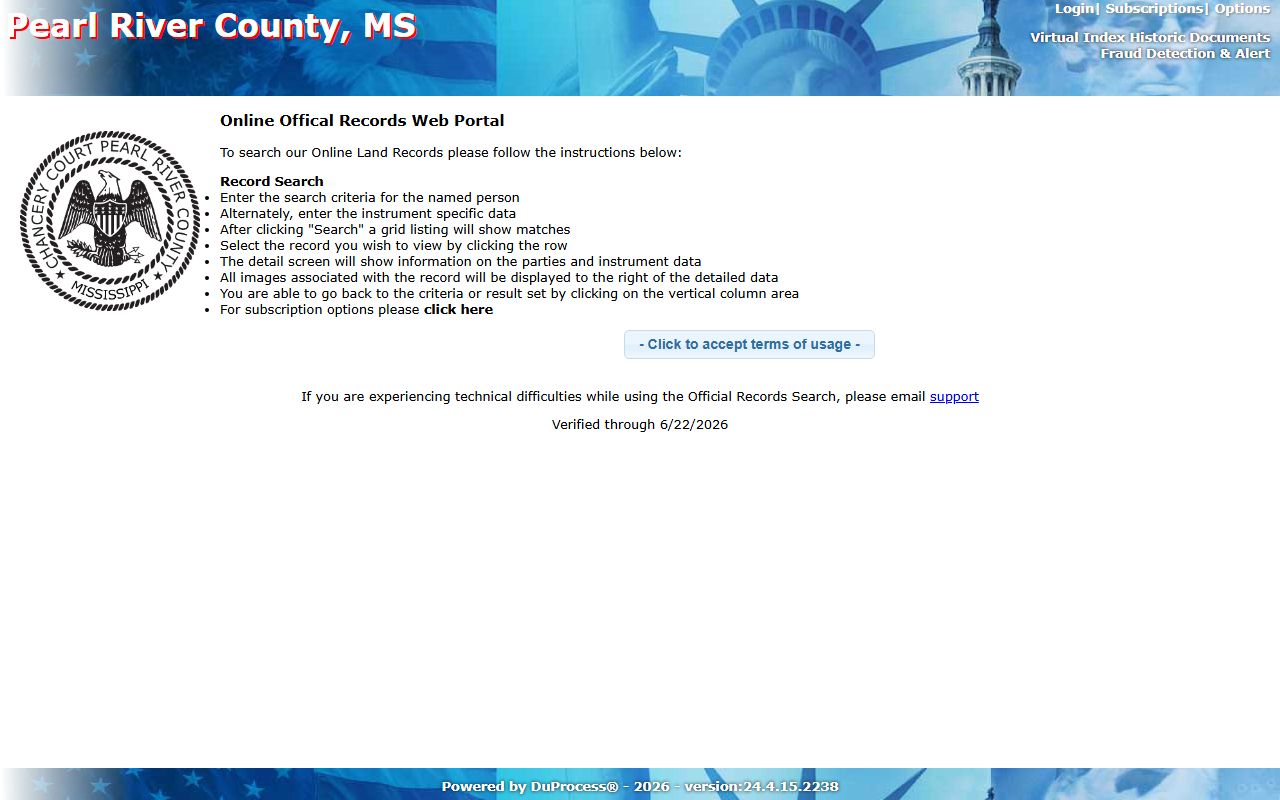
The portal searches by party name, instrument number, book and page, or recording date. For dockets that are not online, the clerk counter is the reliable fallback. A visit or call to the clerk that owns the file can confirm whether a case is public, whether it is digitized, and what a certified copy costs.
One online tool is often mistaken for a docket search. The county uses nCourt for online payments on tickets and court amounts.
Important: nCourt is payment infrastructure only. It collects fines and court costs and never serves as a record-search or docket-lookup portal.
Anyone planning to contest a ticket should reach the court clerk before paying, since a payment can be treated as a plea. Court records in the county also overlap, so a docket question sometimes leads to the broader Pearl River County court records channels for the full file.
Restricted Pearl River County Dockets
Some dockets are closed or limited by law, and a public search will not return them. Youth Court dockets are confidential under Mississippi Code Section 43-21-261, with access generally limited to parties, attorneys, agencies, and people the court authorizes. Adoption matters are protected under Mississippi Code Section 93-17-25.
Sealed and expunged cases also drop off public dockets. A sealed file stays hidden unless a judge later orders release. Once a record is expunged under Mississippi Code Section 99-19-71, the public-facing docket should no longer appear in an ordinary lookup. Mental-health proceedings are restricted because they carry medical and personal details. Even on open dockets, personal identifiers such as Social Security numbers, full birth dates, and the addresses of protected people may be redacted.